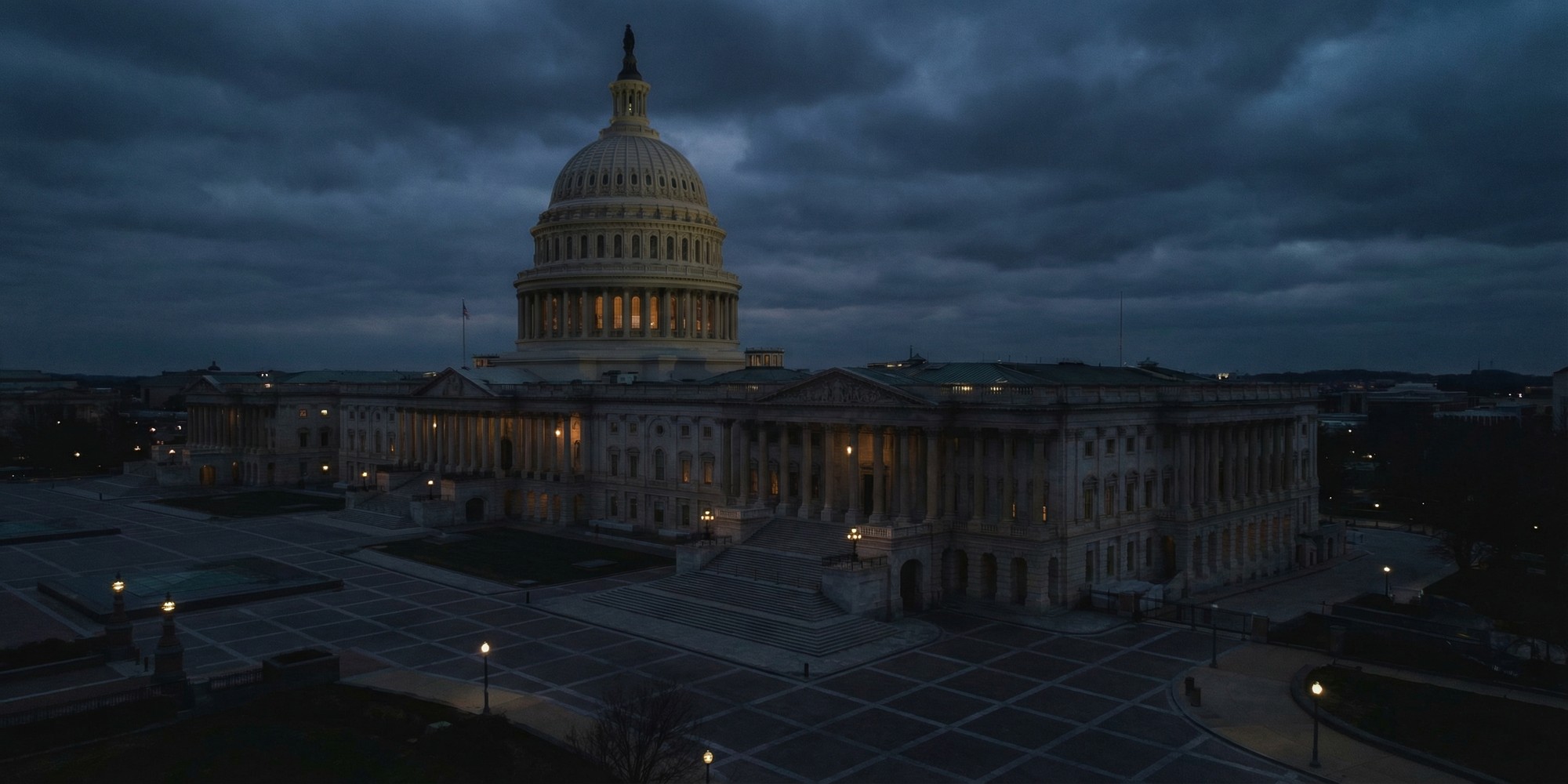
Four votes. The same nine-vote gap, every time. Thirty-four days without a deal, and a Senate recess deadline looming in ten days. The Department of Homeland Security's partial funding lapse — now the second-longest DHS-only shutdown in modern history — has produced a remarkably consistent pattern: the Senate votes, falls short of 60, and adjourns without resolution.
The mechanics are straightforward, even if the politics are not. Under Senate Rule XXII, ending debate on a bill requires a cloture vote — and cloture requires 60 votes, or three-fifths of all senators duly sworn. A simple majority of 51 is not enough to advance legislation when the minority chooses to use the filibuster. Since February 12, 2026, 47 Senate Democrats have largely held together to deny Republicans the votes needed to proceed to a final vote on H.R. 7147, the DHS Appropriations Act for FY2026.
The Mechanics of Deadlock
To understand why the Senate has voted four times and passed nothing, it helps to understand the procedural sequence. When Senate Majority Leader Thune files cloture on a motion to proceed to H.R. 7147, he is asking 60 of his colleagues to agree to even begin debate on the bill — before any amendments are offered or a final passage vote is held. This two-step process — cloture to proceed, then potential cloture again before final passage — is what gives the minority real leverage even when the majority controls the calendar.
Democrats, holding 47 seats, need only 41 votes to sustain a filibuster. They have 47. The lone crossover is Sen. John Fetterman (D-PA), who has voted with Republicans on all four cloture attempts. The margin has been consistent: 51 or 52 yeas against 45–47 nays — 9 votes short of the 60 required every single time.
| Vote | Date | YEAs | NAYs | Not Voting | Result |
|---|---|---|---|---|---|
| Vote #38 | Feb. 12, 2026 | 52 | 47 | 1 | FAILED |
| Vote #39 | Feb. 24, 2026 | 50 | 45 | 5 | FAILED |
| Vote #47 | Mar. 5, 2026 | 51 | 45 | 4 | FAILED |
| Vote #54 | Mar. 12, 2026 | 51 | 46 | 3 | FAILED |
Notably, on Vote #54 on March 12, Majority Leader Thune voted NAY — a parliamentary maneuver that preserves his right to bring the matter back to the floor for reconsideration without requiring a new filing. It is a procedural formality, but it signals that leadership has not given up on a fifth attempt before recess.
"The Democrats' reckless DHS shutdown is causing TSA officers to go without pay for the third time in nearly six months. These political stunts are causing unneeded financial hardship for our TSA officers and their families."
— Lauren Bis, DHS Acting Assistant Secretary · DHS.gov, March 17, 2026
The Cost in People
The cloture math has a human cost that accumulates daily. According to a DHS press release dated March 17, 2026, 366 TSA officers have left the force since the partial shutdown began on February 14 — departures the agency describes as directly attributable to the pay lapse. Each replacement officer requires four to six months of training and certification, meaning these losses will create persistent security staffing gaps well beyond any eventual deal.
At airports already operating near capacity during spring break travel season, the attrition is visible in wait times. Callout rates — the share of scheduled officers who do not report for their shift — spiked to 55% at Houston Hobby International Airport on March 14, one of the highest single-location callout rates recorded during any federal staffing crisis. Atlanta and New Orleans also recorded 30%+ callout days in the same week. Travelers at major hubs are reporting security wait times of two to three hours — a logistical stress test with no immediate resolution.
The 50,000+ TSA agents currently working without regular pay are doing so for the third time in six months — a pattern that, by the agency's own accounting, is accelerating attrition among experienced screeners who have less financial cushion than their counterparts in higher-paid federal roles.
The DHS Budget Structure and the OBBBA Buffer
One detail that has received little attention in coverage of the shutdown: only approximately 8% of the DHS workforce is actually furloughed during this lapse. The reason is the One Big Beautiful Bill Act (OBBBA), signed in July 2025, which included roughly $180 billion in multi-year reconciliation funding for DHS agencies. CBP received $12 billion for personnel and equipment, ICE received $45 billion for detention operations plus $30 billion in broader operational funding, and other DHS components also drew OBBBA allocations.
This means CBP and ICE personnel — the agencies at the center of the Democratic position — are largely funded and operational. The irony of the political standoff is that the component of DHS Democrats most want to constrain (immigration enforcement) is exactly the component insulated from the funding lapse by OBBBA money. The components actually bearing the shutdown's operational cost are TSA, the Coast Guard, and FEMA preparedness operations — agencies with no controversy on either side of the aisle.
The underlying fiscal picture is further complicated by a CBO analysis from October 2025 of the previous government shutdown, which estimated that sustained funding lapses reduce annualized real GDP by 1 to 2 percentage points and generate $7–14 billion in permanent economic loss — output and income that does not recover after the shutdown ends.
All four cloture vote totals are drawn directly from official U.S. Senate roll call records at senate.gov. Vote #38 and Vote #54 links resolve to specific vote pages; Votes #39 and #47 numbers are sourced from the same public Senate roll call database. TSA attrition data (366 departures, 55% callout peak) is from an official DHS.gov press release dated March 17, 2026. The 8% furlough figure reflects DHS's furlough procedures as applied under the OBBBA funding structure; the underlying DHS procedures document is available at dhs.gov. CBO economic impact data is from A Quantitative Analysis of the Effects of the Government Shutdown on the Economy (CBO, October 2025, Publication 61823). CRFB analysis was consulted for context on budget structure but is not a primary source.
Note: H.R. 7744, a revised bill passed by the House approximately March 6, 2026, is not the bill being voted on in Senate cloture. The Senate cloture votes above all relate to H.R. 7147. Per Congress.gov, H.R. 7147 passed the House 220–207 on January 22, 2026.
The Clock: Ten Days to Recess
The Senate is scheduled to recess from March 30 through April 10. If a deal is not reached before that date, the DHS shutdown — already 34 days old as of this writing — extends into week eight with no floor votes possible for another ten days after that. Democrats' stated position is that they will not restore CBP and ICE appropriations without immigration enforcement reforms; Republicans and the White House have engaged in negotiations but have not publicly signaled willingness to modify the bill's substance.
The five-vote gap between what Democrats are willing to provide (effectively 51–52 yeas) and what Senate rules require (60) is not unusual in post-2010 Senate history, where most major legislation has run into exactly this dynamic. What is unusual is the duration: at 34 days, the DHS funding lapse is already the second-longest DHS-specific shutdown on record, and it is accumulating real operational costs — not as abstract budget line items, but as resigned officers, lengthening security lines, and a workforce being tested past its retention threshold for the third time in six months.
Whether a fifth cloture vote materializes before recess, or whether talks produce an agreement that bypasses the procedural threshold entirely, the roll call record is now fixed: four attempts at the 60-vote threshold, four failures, and an identical 9-vote margin each time. The Senate's supermajority rules — designed to protect minority rights and encourage compromise — have turned a single-agency funding dispute into a weeks-long disruption of one of the most visible parts of the federal government.
Primary Sources
- U.S. Senate Roll Call Vote #38 — Feb. 12, 2026 — Cloture on Motion to Proceed, H.R. 7147; YEAs 52 / NAYs 47
senate.gov/legislative/LIS/roll_call_votes/vote1192/vote_119_2_00038.htm - U.S. Senate Roll Call Vote #54 — Mar. 12, 2026 — Cloture on Motion to Proceed, H.R. 7147 (4th attempt); YEAs 51 / NAYs 46
senate.gov/legislative/LIS/roll_call_votes/vote1192/vote_119_2_00054.htm - H.R. 7147 — 119th Congress — DHS Appropriations Act, FY2026; House passage 220–207 (Jan. 22, 2026)
congress.gov/bill/119th-congress/house-bill/7147 - DHS — "Spring Break Under Siege" Press Release — Mar. 17, 2026 — TSA attrition data, callout rates, pay lapse documentation
dhs.gov/news/2026/03/17/spring-break-under-siege… - CBO — Quantitative Analysis of Government Shutdown Effects — October 2025 — GDP impact, wage loss estimates, Publication 61823
cbo.gov/publication/61823