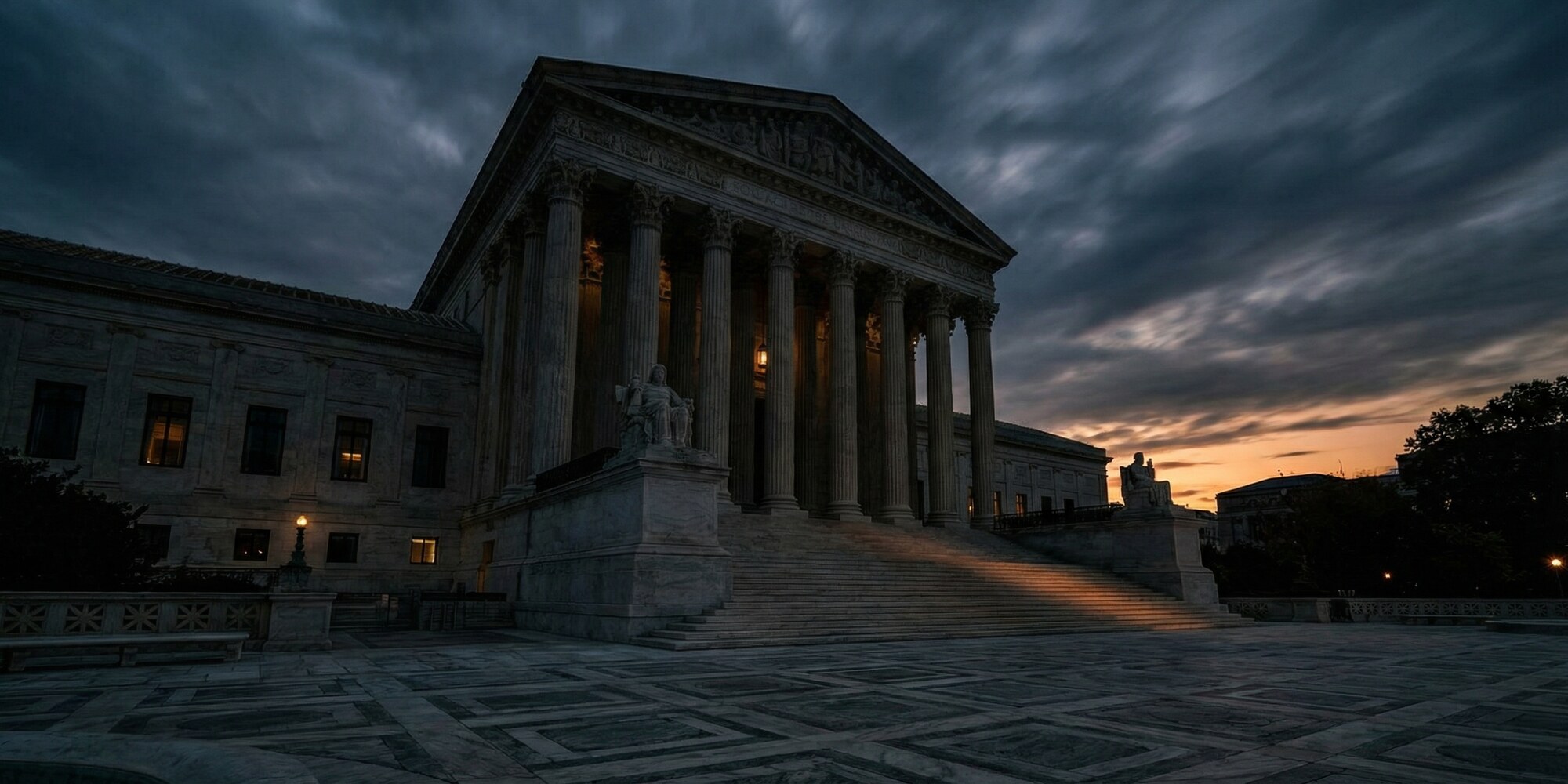
On February 20, 2026, the Supreme Court issued its most consequential trade law ruling in decades — a 6-3 decision holding that the International Emergency Economic Powers Act does not authorize the President to impose tariffs. The ruling voided the entire "Liberation Day" tariff architecture assembled over ten months, triggering refunds on $166 billion in unconstitutionally collected duties and forcing the administration to pivot, within hours, to an entirely different statutory framework. What followed illuminates how thinly Congress's trade authority statutes actually specify the boundaries of executive power — and how much depends on which law is invoked.
Liberation Day: An Emergency Power Without Precedent
In April 2025, the Trump administration invoked IEEPA — a 1977 statute designed to let the President respond to national security and economic emergencies by restricting financial transactions — to impose what it called "reciprocal tariffs." Executive Order 14257, signed in a Rose Garden ceremony, established baseline duties of at least 10% on goods from nearly all countries, with sharply elevated rates targeting nations with which the United States ran persistent trade surpluses. The administration simultaneously used IEEPA to close the de minimis exemption on low-value shipments.
The legal theory was aggressive. IEEPA had never been used to impose tariffs. Its text authorizes the President to "regulate" and "prohibit" international transactions in a declared emergency — language the administration argued encompassed import duties. Legal scholars and trade lawyers widely disputed this reading from the outset. The Court of International Trade agreed, ruling that IEEPA did not provide tariff authority. The Federal Circuit affirmed. The Supreme Court granted certiorari and heard arguments in January 2026.
Between April 2025 and the ruling, the average effective U.S. tariff rate rose from approximately 2.5% to a peak of 27% — the highest in over a century, according to the Yale Budget Lab. U.S. Customs and Border Protection collected at least $166 billion in duties during the ten-month IEEPA tariff period from businesses across more than 330,000 importers.
The Ruling: IEEPA Does Not Authorize Tariffs
The Supreme Court's decision in Learning Resources, Inc. v. Trump, 607 U.S. ___ (2026), consolidated with V.O.S. Selections, Inc., et al., was authored by Chief Justice Roberts. The 6-3 majority held that the International Emergency Economic Powers Act, by its text, structure, and history, does not grant the President authority to impose tariffs. The Court vacated the Federal Circuit's judgment (No. 24-1287, 784 F. Supp. 3d 209) and remanded with instructions to vacate the tariff orders.
"IEEPA does not authorize the President to impose tariffs."
— Chief Justice Roberts, Learning Resources, Inc. v. Trump, 607 U.S. ___ (2026), No. 24-1287
The ruling left two other major tariff frameworks intact. Section 232 tariffs — imposed under the Trade Expansion Act of 1962 on national security grounds — were not before the Court and remain in effect on steel (50%), aluminum (50%), automobiles, and copper. USMCA-based arrangements with Canada and Mexico also survived. The decision was narrowly scoped: IEEPA cannot serve as tariff authority; the other statutes were not addressed.
The three-justice dissent, led by Justice Thomas, argued that the majority had improperly construed IEEPA's broad "regulate or prohibit" language and that tariffs — a traditional form of import regulation — fell within the statute's plain text. The majority's response was rooted in the major-questions doctrine: an agency or executive power of this consequence requires clear congressional authorization, which IEEPA does not provide.
$166 Billion in Refunds: The Customs Reckoning
The immediate administrative consequence of the ruling is unprecedented in customs history. U.S. Customs and Border Protection is now tasked with processing refunds on $166 billion in duties collected from more than 330,000 businesses. CBP has not committed to a public timeline. Importers must typically file a protest within 180 days of liquidation; the administration has not announced an expedited mechanism, and the logistics of refund processing at this scale have no modern precedent.
For businesses that front-loaded imports in late 2024 and early 2025 to beat anticipated tariff increases — contributing to the record -$135.9 billion trade deficit in March 2025 — the refund represents a significant cash flow recovery. For smaller importers that could not absorb the costs and went out of business or canceled orders, refund eligibility may exist but the financial damage has already occurred. See our trade and deficit data dashboard for current trade balance tracking.
The Section 122 Pivot: A Narrower Tool With Hard Limits
Within hours of the Supreme Court ruling on February 20, 2026, the administration issued a Presidential Proclamation invoking Section 122 of the Trade Act of 1974 (19 U.S.C. 2132). Unlike IEEPA, Section 122 explicitly authorizes tariff surcharges — but with significant statutory constraints that IEEPA did not carry.
| Authority | Status | Scope | Duration Limit | Current Rate |
|---|---|---|---|---|
| IEEPA | Struck Down | All imports (was) | Indefinite (was) | N/A |
| Section 122 | Active | All imports (ex. exclusions) | 150 days (~Jul 24) | 10% |
| Section 232 | Intact | Steel, Aluminum, Autos, Copper | Indefinite | 50%+ (steel/alum) |
Section 122 allows the President to impose surcharges to address "fundamental international payments problems" — specifically large and serious balance-of-payments deficits. The administration's proclamation cited a current account deficit of -4.0% of GDP in 2024 (the largest since 2008), a goods trade deficit of $1.2 trillion in 2024, and a net international investment position of -$26 trillion (89% of GDP). The surcharge rate: 10% ad valorem on all covered imports, effective February 24, 2026. Expiration: approximately July 24, 2026 — the hard 150-day ceiling written into the statute.
Section 122 carries extensive exclusions that IEEPA did not: goods subject to Section 232 actions, USMCA-compliant goods from Canada and Mexico, energy products, critical minerals, pharmaceuticals, certain electronics, automobiles and light trucks, certain aerospace products, and selected agricultural commodities. The de minimis exemption closure remains in effect under a separate Executive Order. The administration has threatened to escalate to a 15% rate if trading partners retaliate.
Trade Deficit Before and After: What the BOPGSTB Data Shows
The trade balance data from FRED/BEA (Series BOPGSTB) tells the story of tariff-era distortions with unusual clarity. The U.S. goods and services trade deficit peaked at a record -$135.9 billion in March 2025 — driven not by actual trade trends but by importers front-running the anticipated tariff regime, pulling months of inventory forward. By October 2025, as that front-running reversed and inventories normalized, the deficit had collapsed to -$31.1 billion. It has since re-stabilized in the $55–73 billion monthly range consistent with pre-tariff-era baselines.
The February 2026 reading of -$57.3 billion — effectively the first post-SCOTUS data point — is in line with the monthly averages that characterized 2019–2024. Whether the Section 122 surcharge produces a sustained narrowing of the goods deficit is an open empirical question; the statute's 150-day window limits the time available to observe a structural effect before the authority lapses.
What's Still in Play: State Suits, Section 301, and Section 232
The SCOTUS ruling resolved the central IEEPA question but left several active legal and policy questions open. Several states, led by New York, have filed suit challenging the Section 122 surcharge as exceeding the statutory scope — arguing that the balance-of-payments finding required by Section 122 does not support a blanket global surcharge. These cases are in early stages as of April 2026. The administration's legal position is stronger under Section 122 than it was under IEEPA — the statute explicitly authorizes surcharges — but the procedural requirements for the triggering finding create potential vulnerabilities.
Meanwhile, the U.S. Trade Representative has been directed to initiate new Section 301 investigations into "unreasonable and discriminatory acts, policies, and practices" of trading partners — building the legal foundation for a second round of country-specific tariffs independent of the Section 122 global surcharge. Section 301 authority is well-established (it was the basis for the 2018–2019 China tariffs), operates without a 150-day ceiling, and can produce durable tariff schedules. GTP's earlier analysis of the 76-economy USTR investigation tracks this parallel track in detail.
The Section 232 tariffs — steel, aluminum, autos, copper, and pending categories including large-scale batteries, cast iron, plastic piping, and industrial chemicals — remain fully intact and were never dependent on IEEPA authority. They represent the third pillar of the administration's trade agenda and the one with the most established legal footing.
IEEPA (struck down): International Emergency Economic Powers Act, 50 U.S.C. § 1701 et seq. (1977). Authorizes President to regulate economic transactions during declared national emergencies. The Supreme Court held in Learning Resources, Inc. v. Trump (Feb 20, 2026) that this does not include tariff authority.
Section 122: Trade Act of 1974, 19 U.S.C. § 2132. Explicitly authorizes the President to impose import surcharges up to 150 days to address fundamental balance-of-payments problems. Statutory ceiling; cannot be extended without new legislative action.
Section 232: Trade Expansion Act of 1962, 19 U.S.C. § 1862. Authorizes tariffs on national security grounds. Not before the Court in Learning Resources; remains fully in effect on steel, aluminum, autos, copper.
Trade balance data: FRED/BEA Series BOPGSTB — monthly U.S. goods and services trade balance. Accessed April 2026 via fred.stlouisfed.org/series/BOPGSTB. SCOTUS ruling: supremecourt.gov, No. 24-1287. Section 122 proclamation: whitehouse.gov.
Primary Sources
- supremecourt.gov — Learning Resources, Inc. v. Trump, 607 U.S. ___ (2026), No. 24-1287 (Feb 20, 2026)
- whitehouse.gov — Presidential Proclamation: Imposing a Temporary Import Surcharge Under Section 122 (Feb 20, 2026)
- fred.stlouisfed.org — Trade Balance: Goods and Services, Series BOPGSTB (BEA/FRED, accessed Apr 2026)
- ustr.gov — Presidential Tariff Actions (USTR, updated)
- whitehouse.gov — Fact Sheet: President Trump Imposes Temporary Import Duty Under Section 122 (Feb 20, 2026)