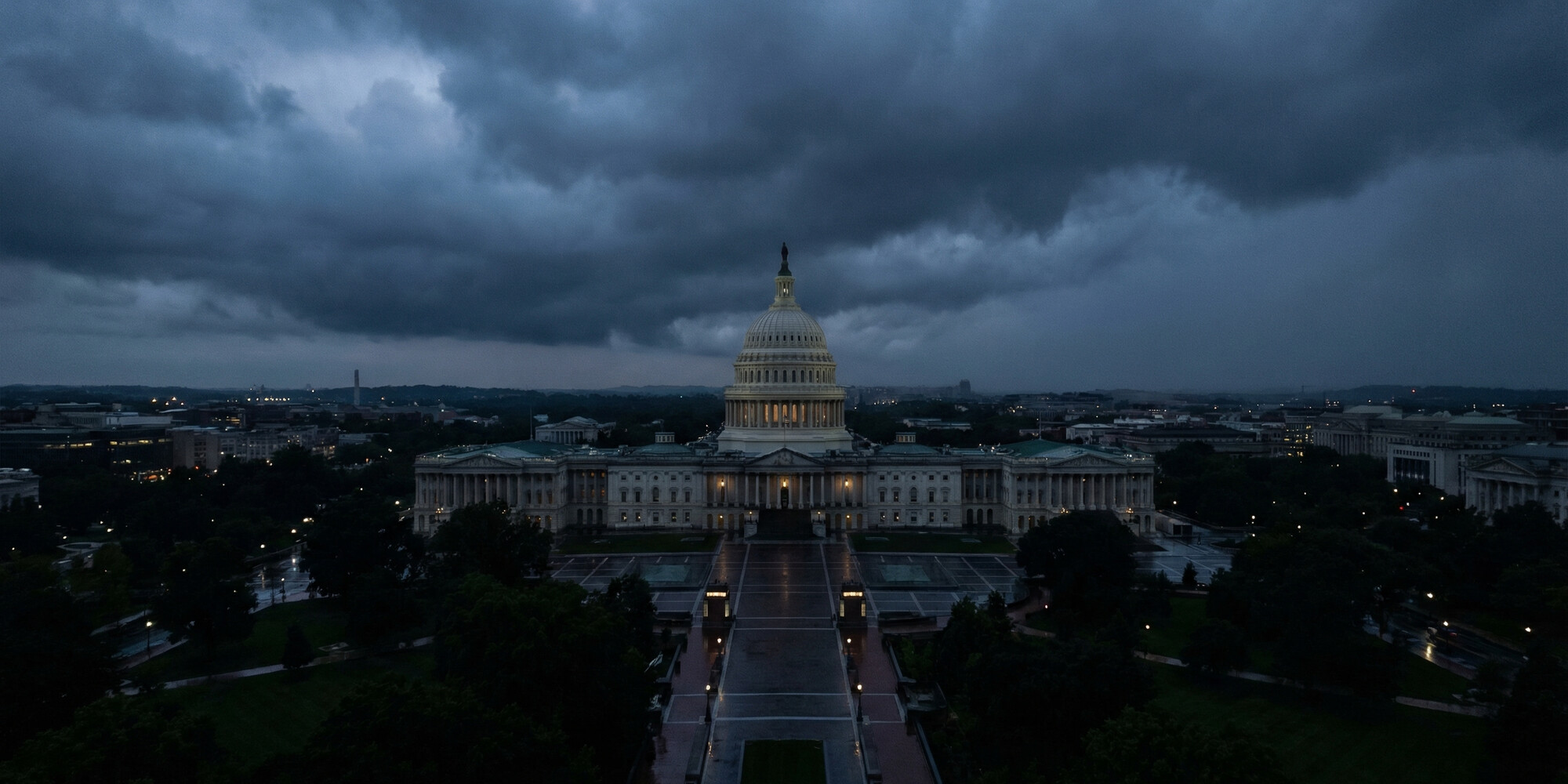
For the first time in United States history, the federal government paid more than $1 trillion in a single year simply to service its accumulated debt. The Congressional Budget Office's Monthly Budget Review for fiscal year 2025 confirmed what economists had long warned: net interest on the federal debt — the cost of borrowing before a single program dollar is spent — has crossed a threshold no prior administration had ever reached.
According to the Federal Reserve's FRED database (series FYOINT), gross interest payments on federal debt totaled $970.4 billion in FY2025 (the fiscal year ending September 30, 2025). The CBO's net figure, which accounts for intragovernmental offsets and credits, exceeds the $1 trillion mark — representing approximately 14.3% of all federal spending that year and making interest on the debt the second-largest line item in the U.S. budget, behind only Social Security.
Federal revenues in FY2025 totaled $5.2 trillion, producing a deficit of $1.8 trillion — equal to −5.77% of GDP, per FRED series FYFSGDA188S. In practical terms, the government borrowed $1.80 for every $1.00 it fell short, and then spent $1 trillion of that borrowing — effectively — just to pay the interest on previous borrowing.
How We Got Here
The trajectory of interest costs over the past four years tells the story with unusual clarity. In FY2021, interest payments on federal debt totaled $352.3 billion — already a large number, but manageable as a share of a $7.2 trillion budget. By FY2025, that figure had nearly tripled.
| Fiscal Year | Interest Payments | YoY Change | Scale |
|---|---|---|---|
| FY2021 | $352.3B | — | |
| FY2022 | $475.9B | +35.1% | |
| FY2023 | $659.2B | +38.5% | |
| FY2024 | $881.0B | +33.6% | |
| FY2025 | ~$1.0T | +10.1% | |
| FY2026 (proj.) | $1.0T | CBO est. | |
| FY2036 (proj.) | $2.1T | CBO long-term |
Two forces drove this ascent in tandem: a growing debt stock and a sharply rising interest rate environment. For most of 2020 and 2021, the Federal Reserve held its benchmark rate near zero to support the pandemic-era economy, which kept the government's borrowing costs artificially suppressed even as debt accumulated rapidly. When the Fed pivoted — raising rates aggressively beginning in March 2022 — the Treasury's cost of rolling over maturing debt climbed with each refinancing cycle.
According to Treasury Fiscal Data on average interest rates, the weighted average rate across all outstanding federal debt stood at 3.320% as of February 28, 2026 — compared to historic lows near 1.6% in 2021. Treasury Bills carry the highest average rate at 3.720%, while longer-dated Treasury Bonds average 3.377%. As legacy low-rate bonds mature and are replaced by new issuance at prevailing market rates, the effective cost of carrying the entire debt stock will continue rising.
Net interest on the public debt, for the first time, surpassed $1 trillion.
— CBO Monthly Budget Review: Summary for Fiscal Year 2025 (cbo.gov/publication/61307)
The Budget Displacement Effect
The $1 trillion interest bill is not an abstraction. It represents a permanent first-dollar claim on federal revenues — money that must be paid before Congress appropriates a single dollar for defense, education, healthcare, or infrastructure. In FY2025, that constraint became more visible than at any prior point in American fiscal history.
Federal interest payments in FY2025 exceeded the entire national defense budget — estimated at approximately $850–900 billion for that year — making debt service the largest single discretionary-comparable expenditure in the federal ledger. It now sits behind only Social Security (mandatory, formula-driven) as a budget line item. This inversion — interest ahead of defense — was not true as recently as FY2022, when interest costs totaled $476 billion and remained well below defense appropriations.
For additional context, see GTP's debt dashboard, which tracks total public debt and its composition in real time using Treasury Fiscal Data feeds.
The Debt Trajectory
The underlying debt continues to expand. Treasury Fiscal Data's Debt to the Penny records the total national debt at $38,918,862,057,676.91 as of March 10, 2026 — approximately $38.92 trillion. Of that total, $31.30 trillion is debt held by the public (borrowed in capital markets from investors, foreign governments, and financial institutions), and $7.62 trillion consists of intragovernmental holdings, primarily Social Security and Medicare trust funds.
As a share of the economy, federal debt reached 122.3% of GDP in Q4 2025, per FRED series GFDEGDQ188S. Year-over-year, total debt grew approximately 6.34% — faster than nominal GDP growth — meaning the debt ratio continues to drift upward in the absence of structural fiscal changes.
Embedded in the $38.9 trillion figure is a compounding refinancing dynamic. Every bond or note that matures and is rolled over at today's higher rates adds permanently to the base interest expense — even if total debt holds flat. Since total debt is not holding flat (the FY2025 deficit added $1.8 trillion), the interest cost trajectory faces two reinforcing upward pressures: more principal outstanding and higher rates on each rollover.
What Comes Next
The CBO's Long-Term Budget Outlook for 2025–2055 projects that net interest will total $16.2 trillion over the decade from 2026 through 2036. In individual fiscal year terms: $1.0 trillion expected in FY2026, growing to $2.1 trillion by FY2036 — more than doubling today's record cost in ten years.
As a share of GDP, interest is projected to consume 3.3% in 2026 — roughly equivalent to the current share of GDP spent on defense. By 2056, under CBO's long-term baseline, interest costs are projected to reach 6.9% of GDP, exceeding all discretionary spending combined at that point. The CBO does not characterize these projections as inevitable — fiscal decisions, economic growth, and interest rate changes can shift them materially — but they represent the direction of travel under current law.
The FY2025 milestone is in one sense only a number. But numbers become milestones when they mark a qualitative shift in how a country finances itself. The United States is now in the position of borrowing money, at record scale, simply to pay the interest on money it previously borrowed — a dynamic that fiscal economists describe as a structural constraint on future budget flexibility regardless of which party controls government.
Interest payments: FY2025 net interest figure from CBO Monthly Budget Review: Summary for Fiscal Year 2025. Gross interest (FRED FYOINT) = $970,359M for FY2025 year ended 2025-09-30. CBO net figure exceeds $1 trillion after intragovernmental offsets.
National debt: Treasury Fiscal Data — Debt to the Penny, as of 2026-03-10. Debt-to-GDP from FRED GFDEGDQ188S, Q4 2025. Deficit as % of GDP from FRED FYFSGDA188S.
Projections: From CBO Long-Term Budget Outlook: 2025–2055. Average interest rates from Treasury Fiscal Data — Average Interest Rates on Federal Debt, as of 2026-02-28. All sources are approved primary .gov databases.